




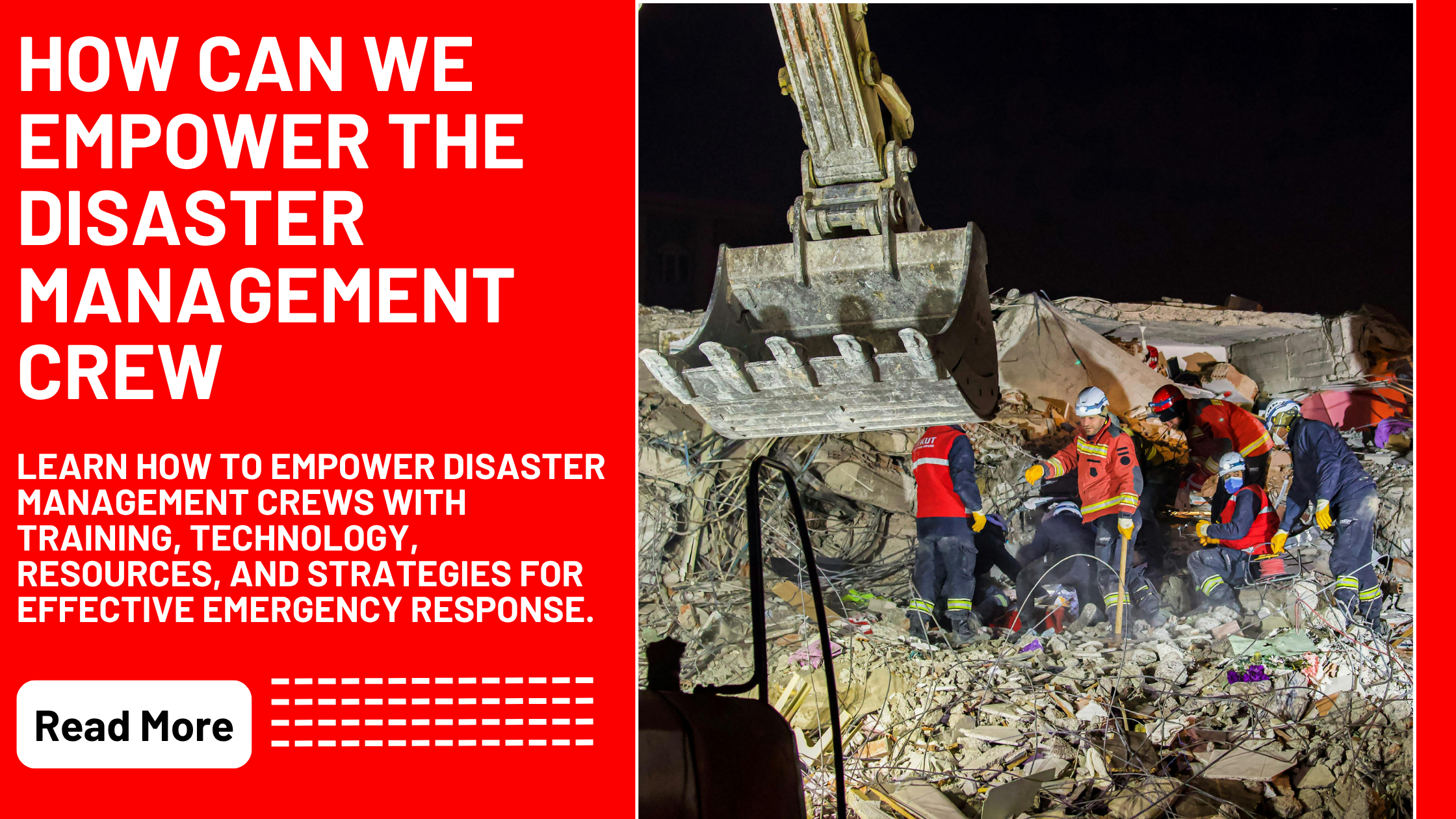
Both natural and man-made disasters are threatening to human lives, infrastructures, and the environment. Whenever a disaster occurs, the disaster management crew is essential towards saving lives, minimizing destruction and restoring sanity in such extreme circumstances. Their success, however, is determined by their equipments, trainings, support and empowerment. Disaster management teams are not to be empowered by simply giving them some tools, but how can we empower the disaster management crew fostering a system that will result in efficient, resilient, coordinated and decision-making. In this paper, the practical strategies, technologies, and frameworks are discussed to enable the disaster management crews so that they will respond faster and in a better way in case of an emergency.
What Is Disaster Management Crew & How Can We Empower The Disaster Management Crew?
A disaster management team is a personnel comprising of professionals and volunteers who will ensure:
Emergency operations and rescue activities.
Medical assistance
Distribution of evacuation and relief.
Infrastructure recovery
Risk evaluation and design.
Such teams can consist of:
Firefighters
Medical personnel
Search and rescue forces.
Government agencies
Volunteers And Non-Governmental Organizations
They play a very important role in mitigating the effects of calamities and guarding communities.
The Importance of empowering Disaster Management Crews.
One, the time required to react to a stimulus is shortened.
Strong Teams Will Be Able To React Swiftly And Minimize Casualties And Damage
2. Better Decision-Making
Situational awareness is enhanced through access to real time data.
3. Improved Coordination
Properly equipped teams would be able to work together in different departments.
4. Increased Safety
Correct devices and training minimize the dangers of responders.
5. Improved Community Confidence.
Effective Disaster Management Instills Trust In The Citizens
The Major Plans To Empower The Disaster Management Crews
1. High-level Training and Human Development.
Effective disaster management depends on training.
The areas of training required are:
- Saving methods of emergencies.
- Health services and first aid.
- Crisis communication.
- Risk assessment.
- The application of innovative machinery.
New Training Procedures:
- Simulation-based learning.
- The training on virtual reality (VR).
- Simulated activities and on-field drills.
Continuous training is done to train the teams to be ready in case of real life emergencies.
2. Advanced Technology Use.
In the present disaster management, technology is of vital importance.
Key Technologies:
- Artificial Intelligence (AI)
- Predicts disasters
- Evaluates the risk trends
- Drones
- Aerial surveillance
- Emergency operations Search and rescue
- Geographic information Systems (GIS)
- Mapping impacted territories
- Tracking resources
- Internet of things (IoT)
- Live observations of the environmental status
Benefits:
- Faster decision-making
- Proper collection of data.
- Improved efficiency
3. Effective Communication Structures.
Communication during the time of a disaster is crucial.
Solutions:
Satellite communication
Emergency radio systems Emergency radio systems provide emergency managers with instant communication and information sharing about emergency conditions.
Advantages:
- Real-time updates
- Better coordination
- Reduced confusion
4. Proper Resources and Equipment.
The personnel who handle the disaster management require the right instruments to work with.
Essential Resources:
- Protective gear
- Rescue equipment
- Medical supplies
- Transportation vehicles
The reason why this matters is that it has the potential to broaden our understanding of the universe and the diverse worlds that exist in it.
Resource Deficit May Cause A Delay In Response And Raise Risks
Mental Health Support: This provision offers assistance to the client by covering the medications and procedure charges for mental health care. Stress and trauma experienced by disaster responders are usually extreme.
Support Measures:
- Counseling services.
- Stress management curriculum.
- Peer support groups are also utilized.
Impact:
- Enhances emotional stability.
- Prevents burnout.
- Improves performance in the long run.
7. Community Involvement and Awareness.
Community empowerment assists the disaster responders to work more effectively.
Community/Ways to Engage Communities:
Awareness campaigns
Volunteer training programs.
Drills in emergency preparedness.
Benefits:
Coverage of local response is quicker.
Less panic when facing disasters.
Improved cooperation with the authorities.
7. Governmental/Policy Support.
The government is instrumental in giving the power to disaster management teams.
Important Actions:
The allocation of funds and budget.
Powerful disaster management policies.
Inter-agency collaboration
Outcome:
An efficient disaster response is provided by an adequately supported system.
Data-driven decision-making involves employing quantitative data in decision-making. Crews are able to respond better with the use of data.
Data Sources:
- Weather forecasts
- Satellite imagery
- Past historical disaster statistics
Advantages:
- Predictive analysis
- Better planning
- Reduced uncertainty
The leadership and coordination must be offered to provide support, produce needs, and synchronize occurrences (Martin, 2015).
Good Leadership Will Provide Seamless Operation In A Crisis
Key Elements:
- Well-defined chain of command.
- There are established roles and responsibilities.
- Quick decision-making.
Result:
The better coordination and less chaos.
10. endless Assessment and Enhancement.
There should be continuous development of the disaster management systems.
Methods:
- Post-disaster analysis
- Interteam Feedback.
- Performance reviews
Goal:
Locate Weaknesses And Make Future Actions Better
Empowerment of Crews in Disaster Management There are difficulties in empowering the disaster management crews. Let’s learn how can we empower the disaster management crew:
1. Limited Funding
The lack of resources may also obstruct preparedness.
2. deficiency in training.
Ineffective staffs will not cope in the face of an emergency.
3. Poor Coordination
Poor communication may cause slowing down of response.
4. Technological Gaps
It is not that all the regions can access advanced tools.
5. Psychological Stress
Pressure cases are mentally health hazardous.
The Future Of Disaster Management Empowerment
Emerging Trends:
Disaster forecasting with the use of AI.
Disaster-resilient city infrastructure.
In rescuing operations, robotics are useful.
Global communication systems in real-time.
Such innovations will ensure that disaster response is quicker, safer and more productive.
Best Practices Towards Successful Empowerment
1. Training is the first strategy that should be employed.
Skill development is necessary.
2. Leverage Technology
Use contemporary equipment to be more efficient.
3. Strengthen Communication
Make sure there are effective communication systems.
4. Concentrate on Well-being.
Treat psychological and physical illness.
5. Encourage Collaboration
Collaborate with populations and organizations.
FAQs
What is the meaning of empowering disaster management crews?
It is the provision of them with the tools, training and assistance to react properly in case of an emergency.
2. What is the significance of technology when dealing with disasters?
Technology enhances faster response, accuracy, and co-ordination.
3. What can the communities do to support the disaster management teams?
Through awareness programs and adhering to safety measures.
4. What are the difficulties of disaster crews?
Scarcity of resources, pressure, trainee deficit and coordination problems.
5. What is disaster management all about?
It also incorporates AI, robotics and enhanced communication systems to respond better.
Conclusion
Working empowerment of disaster management personnel is vital in the event that it helps in saving lives, minimizing damages, and being able to recover promptly in case of an emergency. The doctor does so by emphasizing:
- Training
- Technology
- Resources
- Mental health
- Community involvement
We are capable of developing a system that is resilient, efficient and ready to face any crisis. How can we empower the disaster management crew was in this article. I hope you liked it!!!